Introduction
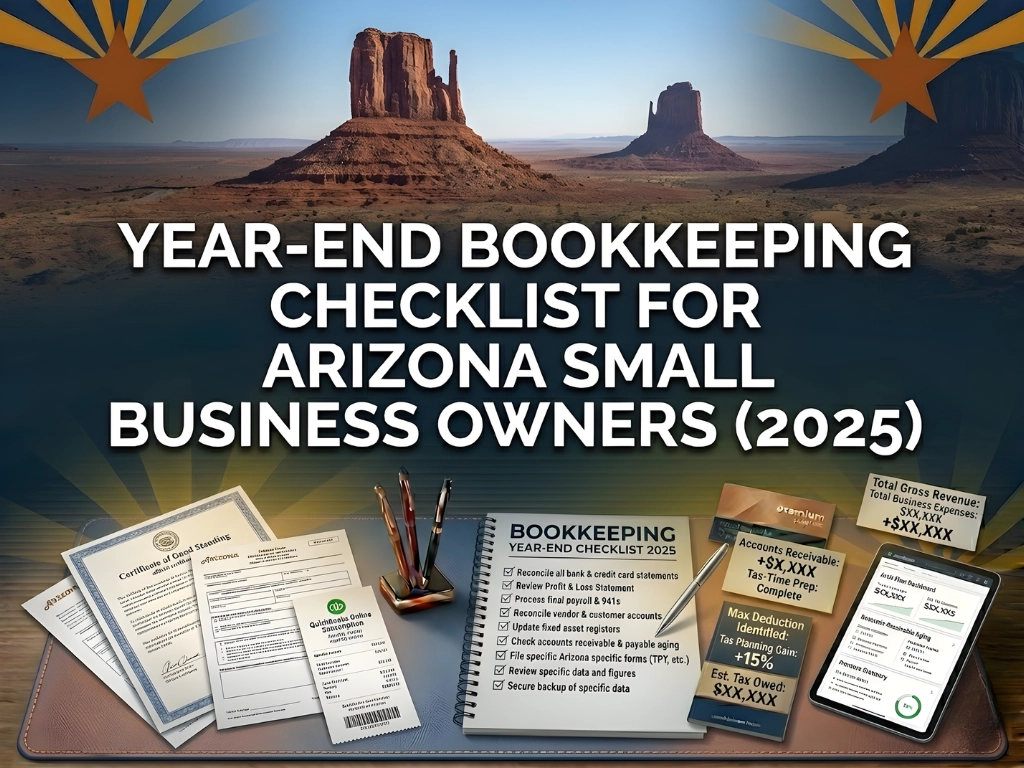
Your Year-End Bookkeeping Checklist
As 2025 winds down, small business owners across Arizona are turning their focus to taxes—but bookkeeping is the foundation of any solid tax return. Whether you handle your books in-house or outsource to a professional, now is the time to close the year with clean records, accurate numbers, and total financial clarity.
This year-end bookkeeping checklist is designed specifically for Arizona small businesses. It’s easy to follow, quick to apply, and will ensure you’re fully prepared for tax season.
Reconcile All Accounts
Start by reconciling your business’s bank accounts, credit cards, and loan statements. This step ensures that every transaction in your accounting software matches your actual statements. Missing or duplicated entries can lead to errors that affect tax liability.
If you haven’t reconciled monthly throughout the year, this is your time to catch up. Most accounting software (like QuickBooks or Xero) makes this easy. Reconciliations should match to the penny.
🔍 Tip for Arizona Businesses: Use this opportunity to double-check if all payments related to Transaction Privilege Tax (TPT) filings were accurately recorded.
Review Accounts Receivable and Payable
Next, check your accounts receivable (A/R). If you have outstanding invoices, decide whether to follow up, write them off, or mark them as bad debt. Writing off bad debt may offer a tax deduction, but it also helps clean up your financial reports.
Review accounts payable (A/P) as well. Make sure you’ve recorded all unpaid bills—utilities, subscriptions, vendors, contractors. Missing these could understate your expenses and overstate profits.
Count and Adjust Inventory
If you manage inventory, now’s the time to perform a year-end count. Compare physical inventory to your records and adjust accordingly. This ensures accurate cost of goods sold (COGS) and can also reveal shrinkage, theft, or spoilage.
📦 Arizona Tax Tip: Obsolete or unsellable inventory may qualify for write-downs. Make sure those adjustments are reflected before year-end.
Record All Major Purchases
Review whether you’ve recorded all fixed asset purchases (equipment, vehicles, computers, furniture, etc.). Purchases made in 2025 and placed in service by December 31 may qualify for Section 179 or bonus depreciation.
Save receipts and label them properly. These records are essential if you plan to claim depreciation deductions or defend an audit.
Organize Your Supporting Documents
A clean ledger is only part of the picture. The IRS and Arizona Department of Revenue require proof of your expenses, income, and deductions.
Make sure you’ve saved:
- Receipts (especially for meals, travel, and equipment)
- Bank and credit card statements
- Mileage logs (especially for vehicle deductions)
- Contracts and invoices
- Payroll reports
Back up your data—digitally and/or physically—and consider using cloud storage for easy access during tax season.
Prepare for Your CPA or Tax Pro
Now that your books are clean, prepare a year-end financial packet for your CPA or tax preparer. Include:
- Final profit & loss statement
- Year-end balance sheet
- A/R and A/P aging reports
- Inventory summary
- Details of major purchases and loans
- Any changes to business structure or ownership
Providing organized, accurate data will not only save you money on tax prep—it’ll also help your CPA find ways to lower your tax bill.
Know When to Outsource
If this checklist feels overwhelming—or you’re discovering gaps in your records—it may be time to outsource your bookkeeping.
Professional bookkeepers (like the team at AZTACS) offer:
- Monthly reconciliations
- Cleanup and catch-up services
- Financial statement preparation
- Year-end reports ready for your CPA
- Compliance with Arizona tax laws (like TPT)
Letting experts handle your books frees up your time and ensures accuracy.
Wrap-Up and Next Steps
Bookkeeping isn’t glamorous—but it’s one of the most important things you can do to protect your business and plan for growth.
By completing this checklist in Q4, you’ll:
- Prevent costly tax mistakes
- Maximize your deductions
- Reduce your stress during tax season
- Be ready for a clean, confident start in 2026
FAQ Section
What is year-end bookkeeping?
Year-end bookkeeping is the process of reviewing and closing your financial records for the calendar year. It ensures everything is accurate for tax filing and reporting.
When should I start year-end bookkeeping tasks?
Start as early as late October or early November to give yourself time for corrections, inventory counts, and professional review if needed.
Can I deduct expenses if they’re paid in January?
Generally, no. Most small businesses use the cash method—expenses must be paid by December 31 to count for the current tax year.
What software is best for Arizona small businesses?
QuickBooks Online, Xero, and Wave are commonly used. Choose one that supports Arizona tax rules (e.g., TPT mapping) and is compatible with your CPA.
Need help getting your books in order before December 31st?
The AZTACS bookkeeping team specializes in Arizona small business needs—from TPT tracking to financial statement prep.
👉 Schedule a free bookkeeping consultation
📞 Or call us at 480-XXX-XXXX